Home
Scholarly Works
Late Pleistocene Human Skeleton and mtDNA Link...
Journal article

Late Pleistocene Human Skeleton and mtDNA Link Paleoamericans and Modern Native Americans

Abstract

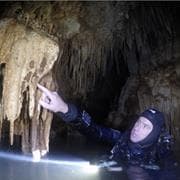
Because of differences in craniofacial morphology and dentition between the earliest American skeletons and modern Native Americans, separate origins have been postulated for them, despite genetic evidence to the contrary. We describe a near-complete human skeleton with an intact cranium and preserved DNA found with extinct fauna in a submerged cave on Mexico's Yucatan Peninsula. This skeleton dates to between 13,000 and 12,000 calendar years ago and has Paleoamerican craniofacial characteristics and a Beringian-derived mitochondrial DNA (mtDNA) haplogroup (D1). Thus, the differences between Paleoamericans and Native Americans probably resulted from in situ evolution rather than separate ancestry.

Authors

Chatters JC; Kennett DJ; Asmerom Y; Kemp BM; Polyak V; Blank AN; Beddows PA; Reinhardt E; Arroyo-Cabrales J; Bolnick DA

Journal

Science, Vol. 344, No. 6185, pp. 750–754

Publisher

American Association for the Advancement of Science (AAAS)

Publication Date

May 16, 2014

DOI

10.1126/science.1252619

ISSN

0036-8075
Contact the Experts team